
Personal loan marketplaces promise convenience, but free quotes costs thousands when your data turns into a bidding war.
Compare rates from multiple lenders in minutes. Get prequalified without impacting your credit score. Find your best deal with one simple form.
The reality tells a different story.
These platforms operate as lead-generation businesses first, borrower advocates second. Your data becomes inventory. Your need for debt relief transforms into their revenue opportunity. The system that appears free and helpful quietly makes borrowing more expensive.
Understanding how personal loan marketplaces actually work reveals why they rarely deliver the savings they advertise.
What Is A Personal Loan Marketplace And How Does It Actually Work?
A personal loan marketplace connects borrowers with multiple lenders through a single application. Popular platforms like LendingTree, Bankrate, and Credit Karma collect your financial information, then distribute it to partner lenders who compete for your business.
The process seems straightforward. You enter details about income, debt, and credit history. The platform runs a soft credit check. Within minutes, you receive multiple loan offers from different lenders.
Behind this simple interface lies a complex web of data sharing and revenue generation.
Direct lenders fund loans using their own capital. Marketplaces act as intermediaries, earning money by connecting borrowers with these lenders. Lead generators focus purely on collecting and selling borrower information to the highest bidders.
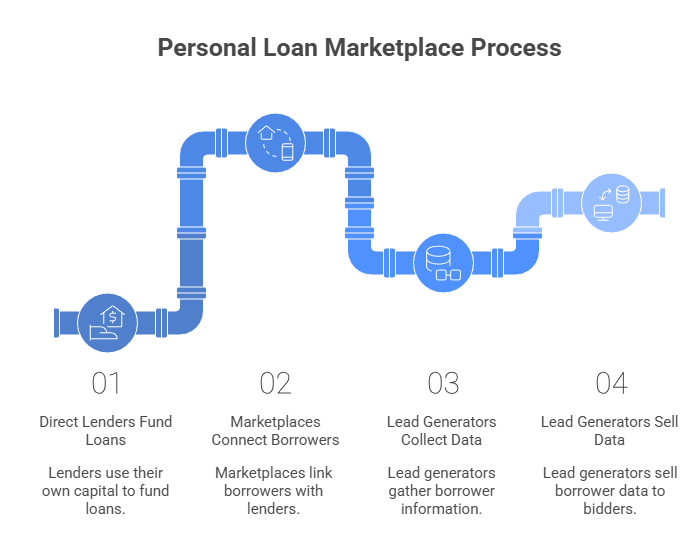
Many platforms combine all three functions. They may operate as marketplaces for some transactions while generating leads for others.
This blended model creates confusion about their primary loyalty.
When you submit information to a marketplace, your data travels to multiple destinations. Partner lenders receive your details to prepare offers. Third-party vendors access your information for credit checks, identity verification, and marketing purposes. Some platforms share data with third-party vendors for services ranging from document verification to debt collection.
Each handoff increases your exposure to data misuse and privacy breaches.
Why Do Personal Loan Marketplaces Look So Attractive When You're In Debt?
redit card balances climb month after month, and once you’re asking how much credit card debt is too much, marketplaces know you’re primed to click.
Minimum payments barely cover interest charges. Multiple due dates create constant stress about missed payments and late fees.
Personal loan marketplaces target this exact pain point, especially people weighing credit card refinancing vs debt consolidation.
They promise consolidation: one loan, one payment, lower interest rates. Marketing messages emphasize speed and convenience. "Get prequalified in minutes." "No impact to your credit score." "See your rate without commitment."
These appeals resonate with borrowers who feel trapped by revolving debt. The prospect of replacing multiple high-interest payments with a single, lower-rate loan offers psychological and financial relief.
Marketplaces amplify this appeal through aggressive advertising. Social media ads target users based on financial stress indicators. Search engine marketing captures people actively looking for debt solutions. Email campaigns promise exclusive rates and limited-time offers.

The combination of genuine financial need and sophisticated marketing creates powerful motivation to act quickly. Borrowers often submit applications before fully understanding the platform's business model or long-term implications.
How Do Personal Loan Marketplaces Make Money, And Why Does That Matter For Your Rate?
Personal loan marketplaces earn revenue through multiple channels. Online marketplace lenders use a variety of different models to generate revenue including charging interest, loan origination and other service fees. Lead fees represent the most common income source. Lenders pay marketplaces for each qualified borrower referral, regardless of whether the loan closes.
Origination-related fees provide another revenue stream. Some platforms earn commissions when referred borrowers complete loans. P2P platforms generate revenue by charging fees to both borrowers and lenders, including origination fees that could be a percentage of the loan amount or follow a fixed scheme.
Advertising partnerships create additional income. Lenders pay for prominent placement on marketplace websites. Featured listings and sponsored results generate revenue separate from lead fees.
This business model creates inherent conflicts of interest. In some instances, only partner lenders that make the marketplace money are represented on the site. Borrowers may not see offers from all available lenders, only those willing to pay for access.
Higher customer acquisition costs ultimately flow through to borrower rates. Lenders must recover lead fees and marketing expenses through interest charges and origination fees. The $50 to $500 that lenders pay per lead gets embedded in loan pricing.
Pressure to convert leads into closed loans intensifies this dynamic. The process is so fast and easy that borrowers may not carefully consider all factors before borrowing. Sales representatives have quotas to meet and limited time to work with each prospect.
This urgency-driven environment rarely produces optimal borrowing decisions.
What Are The Data Privacy Risks Of Personal Loan Marketplaces?
Personal loan applications require extensive sensitive information. Social Security numbers, bank account details, employment history, and income documentation all flow through marketplace systems. This data has significant value to identity thieves and fraudsters.
Digital lending platforms face unique privacy challenges. Digital lenders often have partnerships with third-party or service vendors. This needs them to share the data for credit checks, document verification, collection, and more. Each additional party increases the risk of data breaches or unauthorized access.

Mobile lending apps present particular concerns. Regulatory actions have targeted platforms that misuse the borrower's information, including accessing contact lists to harass borrowers about unpaid balances. Some apps have been removed from app stores for serious privacy violations.
Consumer awareness of these risks continues growing. 87% of consumers said data privacy is a human right, according to a study published by KPMG in 2020. Yet many borrowers still submit applications without fully understanding how their information will be used or shared.
Federal enforcement actions demonstrate the scope of the problem. The FTC has prosecuted lead generation companies for deceptive practices and indiscriminate data sharing. Some cases involved selling borrower information not just to legitimate lenders but to marketers and scam operators.
Privacy policies often contain broad language allowing extensive data sharing. Terms may permit platforms to share information with "affiliates," "partners," or "service providers" without clearly defining these relationships. Borrowers rarely read these policies completely before submitting applications.
The distributed nature of marketplace lending compounds these risks. Unlike direct lenders who maintain control over borrower data, marketplaces create multiple touchpoints where information can be compromised or misused.
Can Using Personal Loan Marketplaces Hurt Your Credit Score Or Long-Term Financial Health?
Credit inquiries fall into two categories with different impacts on credit scores. Soft inquiries occur during prequalification and rate checking. These don't affect credit scores and remain invisible to other lenders. Soft credit pulls won't impact your credit scores, making them safe for comparison shopping.
Hard inquiries happen when you formally apply for credit. Hard inquiries can impact credit scores and remain on your credit reports for up to two years. Each hard inquiry can temporarily lower your credit score by several points.
Personal loan marketplaces blur this distinction. Initial rate checks typically use soft pulls, allowing borrowers to compare offers without credit score damage. However, you'll be subject to a hard credit check when you formally apply by completing your application.
Problems arise when borrowers submit multiple formal applications. Shopping across several marketplaces can result in numerous hard inquiries within a short period. Too many hard credit checks in a short period of time can make lenders see you as a high-risk borrower, reducing approval chances for future credit.

Credit scoring models group similar inquiries within 14-45 days as a single inquiry for scoring purposes. This protection applies to mortgage and auto loans but may not extend to personal loans, depending on the scoring model used.
Borrowers often misunderstand when hard pulls occur. Marketplace marketing emphasizes "no credit impact" during rate checking while downplaying the consequences of formal applications. This messaging can lead to multiple hard inquiries as borrowers apply with several lenders simultaneously.
Do Marketplace-Facilitated Personal Loans Actually Reduce Your Debt Over Time?
Research reveals troubling patterns in marketplace lending outcomes. Studies show that consumers who borrowed from a marketplace lender are, on average, more financially constrained and dependant on credit card debt. These borrowers often use personal loans to consolidate existing debt but struggle with underlying spending patterns.
The most concerning finding relates to long-term debt levels. Research tracking borrowers over time found that 9 months after loan origination, these borrowers are as indebted as they were before origination and have higher default probabilities and higher default occurrences.
This pattern reflects a behavioral trap. Consolidation loans pay off credit card balances, freeing up available credit. Without addressing spending habits, many borrowers gradually rebuild credit card debt while still paying the personal loan. The result: higher total debt than before consolidation.
Successful debt consolidation requires more than just obtaining a lower interest rate, sometimes the first win is learning how to negotiate credit card debt. The borrowers who benefit from MPLs are those who have the financial discipline to avoid drawing down on their subsequently higher credit limits.
Marketplaces rarely provide tools or guidance to address underlying financial behaviors. Their business model focuses on loan origination, not long-term borrower success. Once the loan closes and commissions are paid, platforms have limited incentive to monitor borrower outcomes.
This disconnect between short-term relief and long-term results explains why many borrowers find themselves in worse financial positions despite initially lower payments.
Are Personal Loan Marketplace Algorithms Fair To Every Borrower?
Credit scoring and loan pricing algorithms shape who receives offers and at what rates. These systems process thousands of data points to assess risk and determine pricing. However, nearly all algorithms used in financial services are biased against women and minorities.
Algorithmic bias occurs through multiple mechanisms. A zip code might serve as a proxy for race because of historical housing segregation patterns.
While algorithms don't directly consider protected characteristics, they achieve similar discriminatory effects by using correlated variables.
Research documents significant disparities in lending outcomes. A UC Berkeley study found that African American and Latinx borrowers are charged nearly 5 basis points in higher interest rates than their credit-equivalent white counterparts—amounting to $450 million in extra interest per year.
The proprietary nature of marketplace algorithms compounds these problems. The proprietary nature of algorithms and the complexity of their constructions allow for discrimination to hide behind their supposed objectivity. Borrowers have no visibility into how decisions are made or whether they're being treated fairly.
Data quality issues exacerbate bias problems. When certain populations have thinner credit files (less historical data), the models make less reliable predictions for these groups. This can result in higher rates or loan denials for borrowers who might actually represent good credit risks.
Traditional fairness testing methods prove inadequate for complex AI systems. Traditional fairness testing methods are flawed when used with simple algorithms, but with AI-based algorithms, they don't work at all. This leaves borrowers with little recourse when facing potentially discriminatory outcomes.
Regulatory oversight of algorithmic fairness remains limited. While fair lending laws exist, enforcement agencies struggle to evaluate complex machine learning models. Marketplace platforms may use biased algorithms without facing meaningful consequences.
What Do Regulators And Consumer Complaints Tell Us About Online Loan Marketplaces?
Federal regulators have taken notice of problems in marketplace lending.
The Consumer Financial Protection Bureau (CFPB) announced it is accepting complaints from consumers encountering problems with loans from online marketplace lenders. This action signals that consumer harm reached levels warranting dedicated regulatory attention.
The CFPB's complaint system reveals common issues. Problems include unclear loan terms, servicing difficulties, and aggressive collection practices. The Consumer Financial Protection Bureau recently started accepting consumer complaints about marketplace lending companies. This shows increased need for protections against predatory practices in the FinTech Industry.
Regulatory complexity creates additional consumer risks. Multiple federal and state regulators regulate marketplace lending arrangements. The traditional model where fintech companies partner with banks raises licensing questions about whether platforms act as brokers, servicers, or debt collectors.
Each role may require separate state licenses, creating a patchwork of regulatory oversight. Fintechs that directly provide certain financial services must secure state-based licenses in each state in which they operate (sometimes all 50). This complexity can create gaps in consumer protection.
Enforcement actions demonstrate ongoing problems. The FTC has prosecuted lead generation companies for deceptive practices, including false advertising about loan terms and unauthorized data sharing. These cases reveal systematic issues in how some platforms operate.

Bank regulators also express concerns about marketplace lending partnerships.
When banks work with fintech platforms, they remain responsible for compliance with consumer protection laws. This shared responsibility can create confusion about which entity handles borrower complaints or regulatory violations.
The complaint data itself provides valuable insights into marketplace performance. Bank Policy Institute's analysis uses CFPB complaint data to examine the personal loan market, including online marketplace lenders.
This data helps identify patterns of consumer harm across different lending channels.
If You Still Use A Personal Loan Marketplace, What Should You Watch Out For?
Personal loan marketplaces can provide value when used carefully. Understanding their limitations and risks allows for more informed decisions. Consider these factors before submitting applications:
Verify lender coverage. Ask which lenders participate in the platform and whether only paying partners receive your information. Some marketplaces exclude lenders who don't pay lead fees, potentially limiting your options.
Read privacy policies carefully. Understand who can access your data and how it may be shared. Look for specific restrictions on data resale or third-party marketing. Avoid platforms with vague language about data sharing.
Limit hard credit inquiries. Keep formal applications within a focused timeframe to minimize credit score impact. Apply only with lenders offering genuinely competitive terms, not every available option.
Compare total loan costs. Focus on annual percentage rate (APR) and total interest paid over the loan term, not just monthly payments. Factor in origination fees, prepayment penalties, and other charges.
Avoid borrowing more than needed. Resist offers for larger loan amounts than necessary to pay off existing debt. Extra cash often leads to additional spending rather than financial improvement.
Create a concrete plan. Develop specific strategies to avoid reusing credit cards after consolidation. Consider automatic payments, spending limits, or even closing accounts to prevent debt accumulation.
Verify offers directly. Contact lenders independently to confirm rates and terms before accepting marketplace offers. Sometimes direct applications yield better terms than marketplace referrals.
These precautions don't eliminate marketplace risks but can reduce exposure to common problems.
How Is Apriority A Smarter Alternative To One-Off Loan Marketplaces?
Apriority operates outside the lead-generation ecosystem that drives marketplace lending. The platform doesn't accept payments from lenders or sell borrower data to third parties. This independence eliminates conflicts of interest that plague traditional marketplaces.
Instead of pushing single loan products, Apriority treats debt as a portfolio requiring continuous optimization. The platform connects to existing credit cards, personal loans, student loans, auto loans, and mortgages. This comprehensive view enables better decision-making about when refinancing or consolidation actually helps.
Continuous monitoring replaces one-time comparisons. Rates change constantly, but most borrowers check only when they remember or see advertisements. Apriority tracks rate movements across thousands of lenders daily, alerting users when meaningful opportunities arise.
This ongoing approach prevents the urgency-driven decisions that marketplaces encourage. Rather than presenting limited-time offers that pressure quick action, Apriority provides context about whether current opportunities represent genuine improvements over existing debt structures.
The platform's recommendations focus on total interest reduction rather than loan origination. Sometimes the best advice is to avoid new debt entirely and focus on accelerated payments. Other times, strategic refinancing can save thousands in interest costs.
How Can Apriority Help You Avoid Common Marketplace Pitfalls?
Traditional marketplaces evaluate each loan application in isolation. Apriority analyzes how new debt fits within your complete financial picture. This comprehensive approach prevents common mistakes like consolidating low-rate debt with high-rate debt, resulting in higher overall interest costs.
The platform's neutral analysis helps evaluate offers you've already received. Rather than relying on lender representations, you can see actual APR calculations and long-term cost projections. This transparency reveals whether marketplace offers truly deliver advertised savings.
Behavioral safeguards address the debt accumulation trap that affects many consolidation borrowers. Apriority can monitor credit utilization across all accounts, alerting you when spending patterns threaten to recreate debt problems. This ongoing oversight helps maintain progress toward debt freedom.
The platform's approach to credit inquiries also differs significantly. Instead of encouraging multiple applications to compare offers, Apriority identifies the most promising opportunities before you apply. This targeted approach minimizes hard inquiries while maximizing approval chances.
Timing optimization represents another key advantage. Marketplace offers often come with artificial urgency ("rates expire in 24 hours"). Apriority tracks rate trends over time, helping you understand whether current offers represent genuine opportunities or marketing pressure.
What Are Your Next Steps If You Want To Escape High-Interest Debt Safely?
Escaping high-interest debt requires more than finding a lower rate - it also means choosing the best credit card payoff methods you can stick with.
Successful debt reduction combines strategic refinancing with behavioral changes that prevent debt accumulation.
Start by understanding your complete debt picture. Calculate total interest costs across all accounts, including credit cards, personal loans, and other obligations. This baseline helps evaluate whether consolidation or other strategies provide meaningful benefits.
Consider the role of continuous monitoring in your debt strategy. One-time rate checks miss opportunities that develop over months or years. Interest rates fluctuate based on economic conditions, your improving credit profile, and lender competition. Systematic tracking captures these opportunities automatically.
Evaluate platforms based on their alignment with your long-term interests. Lead-generation businesses profit from loan origination, not borrower success. Commission-free platforms like Apriority focus on interest reduction rather than transaction volume.
Address underlying spending patterns that created debt problems. Consolidation loans provide temporary relief but often lead to higher total debt without behavioral changes. Create specific plans to avoid rebuilding credit card balances after consolidation.
Personal loan marketplaces promise convenience but deliver conflicts of interest. Their business model prioritizes lender profits over borrower savings. Understanding these dynamics helps you make better borrowing decisions.
Apriority offers a different approach. By eliminating commissions and focusing on continuous optimization, the platform aligns its success with yours. See where you may be overpaying on interest before you apply for another personal loan.