Nearly half of U.S. cardholders carry a balance. That balance costs more than most people realize. Interest charges, late fees, and high APRs pile up. Quietly. Predictably. Expensively.
Credit card debt racks up interest quickly. Many borrowers don’t realize how much they’re overpaying—until they see how the numbers grow over time.
Credit card companies grow their earnings by setting the minimum payment very low. Often, the interest charges for the month are larger than the minimum payment. This means that, even without any spend on the card, paying the minimum will result in a HIGHER balance the next month
Most folks know the first lesson in Debt 101 – avoid carrying balances on credit cards, and yet (nearly 1 in 2 people carry a balance)[https://www.bankrate.com/credit-cards/news/credit-card-debt-report/]. It starts with a plan, a tool, and a clear picture of your numbers. Apriority helps with all three.
How Credit Cards Quietly Drain Your Wallet
A $5,000 balance at 24% APR adds roughly $100 in interest every month. Make just the minimum payment? You might never pay off that balance – that’s how they’re designed.
Many borrowers get surprised by rising balances even without new spending. That’s how interest works. It accrues on your existing balance month after month. Often your minimum payment is not designed to cover the interest. That’s how people not only stay stuck but get in a deeper hole of debt.

Know Your Numbers
Start by getting a clear picture of your current credit card situation. What do you owe? What are your interest rates? Are you paying in full each month, or carrying balances? Our article on borrowers taking back control explains why clarity is the first step to cutting costs."
Apriority makes this step easy. By connecting your credit card accounts, the platform pulls in balances, due dates, interest rates, and payment behavior. Instead of chasing down statements, you get one clean dashboard.
It’s your debt portfolio in plain view.
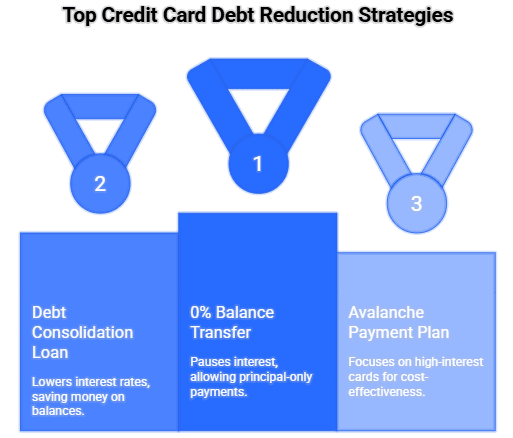
Good: Avalanche payment plan
The most cost-effective payment plan is called the Avalanche method.
This is a method where you pay all your card minimums (to avoid fees and allocate ALL extra payment to the highest interest rate card you hold.
Paying down this balance first is the best way to minimize interest costs. Work hard to make the largest extra payment you can each payheck or month. Once it is done, apply that payment to the next highest interest rate card, and repeat until done.
This is surprisingly effective – but takes dedication, time, and budgeting.
Better: Debt consolidation personal loan
There are even cheaper ways to eliminate credit card debt, and they have to do with utilizing a personal loan (a debt consolidation loan) which, if available at a lower interest rate than your credit card, can save a lot of interest while paying down the balances.
Taking out a new personal loan and using the cash to pay off your highest interest rate cards can drop your interest rate from high 20%’s to often 5-10 points lower APR.
While 10% doesn’t seem like a lot, this can cut your interest down by 30%.
Best
Another method is to leverage 0% balance transfer cards and their promotional period to effectively pause your interest rate allowing you to pay down the principal without accruing any interest.
These come with an up front fee, but are a powerful tool that, when coupled with a repayment plan, can wipe out a large interest cost chipping away at your net wealth.
Which options is best for you? This depends on what you qualify for – and Apriority can help identify, quantify, and simplify this for you.
If You Pay in Full
If your balances are at $0 or you pay in full every month, you're already avoiding interest. That’s the ideal outcome. But there’s still room to get more out of your cards.
Some cards reward you for paying in full. For example, the Fidelity Rewards Visa offers 2% back on all purchases. Amazon’s card gives 5% back on Amazon orders. Cash-back cards can turn routine spending into money back, not money lost.
To stay on track, turn on autopay-in-full. That way you don’t miss a payment, and you keep interest at zero.
If You Carry a Balance
If you’re carrying balances, you’re paying interest. Likely a lot of it. The national average for credit card interest is over 20%.
Here are three ways to break that cycle:
1. Avalanche Method: Target the Highest-Rate Card First
This strategy focuses extra payments on the card with the highest interest rate, while making minimum payments on all others. Once the highest-rate card is paid off, you move on to the next one.
This cuts down the total interest you pay. Every dollar you throw at high-interest debt goes further.

Apriority helps identify which card to target and tracks your progress. You’ll see how much faster you can be debt-free by shifting your payment approach.
2. Personal Loan Refinance
Personal loans can consolidate credit card debt at a lower fixed rate. Instead of juggling multiple cards, you make one payment per month. The interest rate is usually lower, and the payment schedule is more structured.
A $10,000 personal loan at 15% APR over four years saves thousands in interest compared to high-rate credit card debt. Yes, the monthly payment is higher than a credit card minimum, but that’s the tradeoff for faster progress.
Use Apriority to explore whether you qualify. If approved, the platform will walk you through the process.
3. 0% Balance Transfer Cards
A 0% balance transfer card gives you a set window—typically 15 to 21 months—where you can pay off your balance without paying interest. That breathing room can make all the difference.
Let’s say you transfer a $5,000 balance to a 0% card with a 3% transfer fee. That’s $150 upfront, but no interest for over a year. Pay $350 per month, and the balance could be gone before the promo ends.
The catch? Miss one payment, and the promo may vanish. The interest rate could snap back to 25% or more. Autopay is non-negotiable here.
Apriority flags when your 0% period is ending and even helps roll your balance to a new 0% card if needed. That continuous support prevents backsliding.
What Progress Can Look Like
Take Taylor. Age 31. $8,000 spread across three cards:
-$4,000 at 28% APR
-$2,000 at 24% APR
-$2,000 at 17% APR
Using Apriority, Taylor shifts the $4,000 balance to a 0% card with a 5% fee and starts paying it off aggressively. Then, Taylor focuses on the $2,000 card at 24%, using the avalanche method. Finally, Taylor refinances the last $2,000 at 12% using a personal loan.
What started as a 42-month slog turns into an 18-month payoff. Interest savings? Over $4,200.
Pitfalls That Keep Balances High
Success requires consistency. Here are a few habits that keep people stuck:
-Paying less than the minimum
-Skipping autopay
-Opening too many new cards at once
-Consolidating debt, then spending again
-Ignoring end dates on promo periods
Progress doesn’t require perfection, but it does require structure. Apriority builds that into your plan.

Credit Score Myths
Some people carry a balance because they think it helps their credit. It doesn’t.
Credit scores improve with a history of on-time payments, low credit utilization, and long account history. You don’t need debt to build a strong score. In fact, paying off your statement balance in full each monthy and ensuring the utilization (balance divided by maximum allowable spend limit) builds credit score
Generally, it is wise to avoid closing unused credit card accounts. Even with a zero balance, they help your credit score by increasing the average age of your accounts, lower your overall credit card utilization ratio, and may be your longest line (oldest account) of credit – more is good here. Apriority tracks your score alongside your debt payoff, so you can watch both improve together.
Start Paying Less Today
You don’t need a six-figure salary or a financial advisor to get out of credit card debt. You need a clear plan, visibility of better options, and a system that works in the background.
Apriority connects to your accounts, flags high-interest cards, finds real refinance and transfer offers, and walks you through each step. You’ll know exactly which card to pay, which strategy to use, and how long it will take.
The system works quietly, but the savings are loud.
Ready to stop overpaying on your credit card debt?
Use Apriority to take control, reduce your interest, and pay off your debt faster. One dashboard. One strategy. Real results.