
We recognize that true appreciation goes beyond paychecks - that’s why our employee incentives focus on meaningful support, not just monetary rewards.
So here’s gift card for 2 hours of bowling down at the local Lucky Strike.
Thanks for working 12 hours of overtime last month. Please accept this gift card for Chick-fil-A to be redeemed for a free breakfast sandwich.
Let’s build company morale and culture! Pizza in the office this Friday at 13:00! (But don’t forget, we only have a 30-minute lunch break).
Why are you smiling ironically right now, dear reader?
A gift card or a spontaneous office gathering are nice gestures. But these “typical” employee incentives can often come across as thoughtless, and sometimes downright insulting.
It’s really not what keeps someone engaged, loyal, or performing at their best.
Employee Incentives for Todays Talent
Today’s top talent isn’t just looking for treats and a pat on the back.
They’re looking for meaning. For benefits and staff incentives that support real goals. Like paying down debt, development stipends, mental health resources, or other flexible employee benefits.
Build a system where employee incentives actively tick two boxes: drive personal growth and deliver measurable business results..
Think:
- Bonuses for reaching milestones – personal and work related
- Personalised career growth programs
- Extra paid time off for overachievers
- Donation matching for employees’ charity of choice
It's important to note though, that these aren’t fringe ideas. They’re bold moves that build lasting motivation and they’re easier to implement than you think - and they're employee incentives that your competitors are using to poach the talent you're searching for.

In this article, we’ll explore motivational incentives examples that move the needle and highlight new ways to drive behavior that benefits everyone.
Incentives vs Benefits
Let’s not confuse the concept of “employee incentives” with “employee benefits”.
Benefits are built into the employee’s compensation package and are provided on an ongoing basis, usually regardless of the employee’s performance. Think pension plans, private health insurance, paid sick leave. They are almost always non-monetary.
Employee incentives on the other hand – they reward specific performance. Successful completion of a task, hitting a set of KPIs.
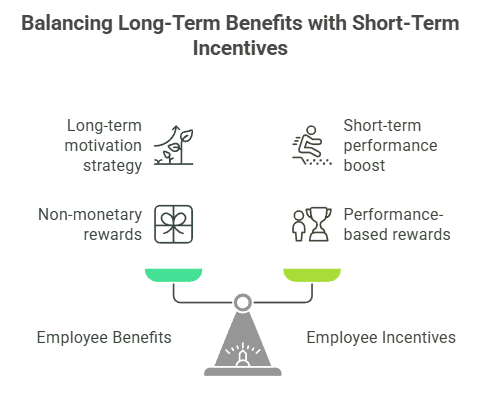
The more innovative employers even provide incentives for hitting certain goals in employees’ personal lives – such as successfully paying off debts.
Benefits are designed as part of a strategy, to continuously motivate employees to be productive and to stay with the company long term. Incentives are designed to motivate employees to achieve good results on a certain task or set of tasks.
Why Are Employee Incentives Valuable in Business?
Employee incentives tell your team what matters, where to focus, and how their actions connect to something bigger than just the task at hand.
When used with intention, incentives for employees have a multiplying effect.
They boost morale, spark motivation, and often lead to better business outcomes.
But just as importantly, they signal care.
That creates buy-in from the employees, not just compliance or obedience.
And the data backs this up:
- A report from SHRM found that companies with strategic recognition programs report 23% lower turnover on average.
- Gallup has shown that employees who feel recognized are 4.6 times more likely to be engaged at work.
The best staff incentives are reflection of your company culture.
Are you a company that values innovation? Then reward creativity.
Do you champion well-being? Incentivize healthier habits or better financial choices.
Incentives become a cultural mirror: they reflect your values, and over time, they shape behavior to align with them.

And incentives, unlike employee benefits, don’t have to be tailored to each individual.
Group targets tied to shared rewards (like learning stipends, wellness challenges, or productivity bonuses) promote alignment and teamwork, not just achievement.
Ultimately, an employee incentives program should do more than acknowledge performance, it should engage the employee in their job – make them enthusiastic about waking up in the morning to go to the office.
See how a smarter loan could become a meaningful incentive within your company’s benefits package.
Incentive Ideas That Go To Work Better Than Gift Cards
Gift cards are easy. But so is forgetting why you got one. If the goal is to motivate real behavior and build lasting engagement, your employee incentives program needs to get more ambitious.
Here are eight incentives for employees that offer more than a quick dopamine hit, and actually support performance, retention, and well-being.
1. Debt Health Challenges (With Micro-Bonuses)
Encourage smart financial decisions by turning them into “gameable” goals.
Example: shifting a credit card balance to a 0% transfer account and setting up auto-pay.

Some credit card companies offer introductory deals where you can move your existing credit card debt to a new card that charges 0% interest for a limited time, often 12 to 18 months
Let’s say you have $5,000 in credit card debt at 20% interest. If you only make minimum monthly payments, you’ll pay a lot in interest, hundreds or even thousands over time.
But if you move that debt to a 0% balance transfer card and pay it off within that interest-free window, you:
- Avoid interest charges
- Pay down your debt faster
- Keep more of your own money
It’s like hitting pause on interest so you can catch up.
When employees save money on debt, it feels like a raise, without increasing payroll. They’re less stressed, more focused, and more likely to stay.
And who doesn’t want to save money?
2. Personalized Career Growth Funds
Skip the generic “learning platform access.” Many challenges your mid to senior-level employees face won’t be solved by a 10-step online course. What they really need is a mentor: someone who’s tackled the same roadblocks and can offer real, experience-driven guidance.
Offer a flexible stipend employees can use on anything tied to personal growth, mentorships, bootcamps, niche courses, or even language lessons that connect them to their family history.
When development feels personal, it becomes sticky, and so does your company culture.
3. Extra Paid Time Off for Performance
Sometimes, the best motivational incentives are the ones that give people space to recharge.
A bonus day off for high performers or team success is a low-cost, high-trust way to say “kick back and celebrate your success”.
4. Weekly/Monthly Challenges
For hitting certain KPIs by the end of the week or month – provide prizes. Prizes can be as small or big as you like.

Some good examples are concert tickets, dinner for two at an upscale venue, tickets to a sporting event, even skydiving. The prizes need to be relevant for as many people as possible.
This will create an environment of friendly competition and really keep the team spirit burning through the course of the competition.
And people will be kept in suspense, waiting to know what the next prize will be!
5. Purpose-Driven Incentives
Offer donation matching or “impact credits” that employees can allocate to nonprofits of their choice.
It lets employees align their rewards with their values and shows your business backs more than just the bottom line.
6. Experience Vouchers
Research shows that experiences beat material rewards when it comes to happiness and memory. Offer incentives like creative classes, local getaways, or curated subscription boxes.
These are more memorable, and far less forgettable than a $25 Amazon gift card.
7. Choice of Projects
Letting successful employees choose the projects they work on may be one of the most underused staff incentives out there. It gives people a sense of ownership, aligns work with their interests, and unlocks more creativity.
Companies like GitHub have seen success with this model, where employees select projects that match their skills and goals within guardrails set by business needs.

Even a simple internal “project board” can go a long way.
When people feel trusted to pick their path, they bring more energy to the work and more loyalty to the team.
8. Reverse Mentorship Credit Bank
Flip the script: reward employees who share niche skills or personal knowledge with peers.
How It Works:
Create a “credit bank” where employees earn points for running mini-sessions (e.g., how I automated my finances, or how I refinanced my student loan).
Accumulated credits can be cashed in for perks: extra time off, wellness stipends, or professional development funds.
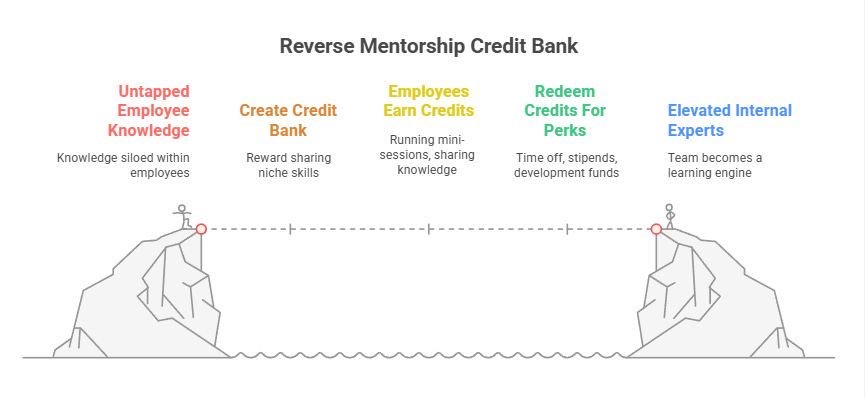
Why It’s Different: It turns your team into a learning engine and elevates the experts already inside your org. Bonus: it builds community, especially across generations or departments.
And let’s be honest – these are the types of topics that employees will often discuss among themselves at the water cooler or coffee machine.
So why not turn it into a useful tool?
How to Incentivize Employees the Right Way
Good employee incentives don’t necessarily need to be personalized down to the individual.
But they do need to be aligned to your business goals and to the reality of how different teams operate.
Sales teams might thrive on monthly performance bonuses linked to how much income they earned for the month.
Devs? Try recognition tied to milestones or innovation. Like a bonus for launching a new feature ahead of schedule, or peer-nominated prizes for solving critical bugs.
Set clear rules, keep it transparent, and make it feel earned. That’s what drives motivation—and momentum.
How Your Company Can Fund Incentives
Implementing effective employee incentives doesn't require a massive budget. Let’s use some practical examples and research data to determine where to get the funds from:
Reallocate Underutilized Perks:
Assess existing benefits or incentives to identify underused offerings. Redirect funds from these areas to more impactful incentives.
Leverage Savings from Reduced Turnover:
Effective incentive programs can decrease employee turnover.
According to the Society for Human Resource Management (SHRM), replacing an employee can cost up to 200% of their annual salary (and up to 400% if we factor in indirect costs.
By investing in retention-focused incentives, companies can realize significant savings which can be better spent on incentives and benefits.
Enhance Productivity:
Incentives that boost employee engagement can lead to increased productivity.
A study by the Incentive Research Foundation found that incentive programs running for a year or more produced an average 44% performance increase.
Implement Cost-Efficient Programs:
Recognition initiatives and financial wellness platforms, such as Apriority, offer scalable solutions that provide substantial value without excessive costs.
Employee Incentive Case Study: Heineken's Revamped Recognition Program
Heineken identified that its existing reward and recognition program was reaching only a small segment of its workforce.
To address this, the company rebranded and repackaged the program, creating a seamless user experience and introducing a diverse range of awards aligned with company values.
This overhaul resulted in a 50% increase in the number of employees recognized by their peers, significantly boosting engagement and morale.
Making Incentives Part of Company Culture
To make employee incentives stick, they need to be more than one-off gestures. Bake them into the rhythm of company life:
Start from Day One: Introduce your incentives program during onboarding so employees know what to expect and what’s valued.
Keep It Visible:
Public shoutouts, digital badges, or especially incentive leaderboards help reinforce the behaviors you want to see more of. Public recognition of good performance is a fantastic motivator.
Make Recognition Routine:
Use review cycles and company meetings to celebrate wins – big or small.
Train Managers:
Equip team leaders with simple tools and examples of how to reward employees meaningfully and consistently.
Implementing Incentives into Your Benefits Package
Employee incentives don’t need to just sit on the sidelines; they can integrate directly into your total rewards strategy.
Platforms like Apriority add depth without extra admin. Our proactive debt optimization tool, for instance, functions as a built-in financial incentive: it continuously finds savings and supports smart money habits.
No paperwork. No micromanagement.
You can use the system as a benefit or an incentive. Whether it’s gamified savings milestones or monthly bonus triggers, incentives like these strengthen your benefits package and boost motivation in one seamless move.
Dump the Gift Cards and Embrace Useful Modern Incentive Systems
Employee incentives are more than perks, they're signals of what your company values.
And it’s reasonable to assume your company’s values have nothing to do with pizza parties or vouchers for fast food breakfast sandwiches, right?
When your incentives are smart, targeted, and easy to manage, they boost performance, strengthen culture, and drive retention.
By thinking beyond gift cards and toward financial wellness, development, and meaningful rewards, you build a system that motivates without micromanaging.
Start small, aim smart, and let your incentives work as hard as your team does.